Last October I did some handstands to get to Philadelphia's Franklin Institute to see National Geographic's exhibit on Egypt's famous Queen Cleopatra, whose formal name was Cleopatra VII Neos Philopator. She was the last ruler of Egypt from the Ptolemaic dynasty of Macedonian Greeks that dated from the days of Alexander the Great. She was also the last Pharaoh of Egypt, period.
"Pharaoh" is an amazingly cool title for a king, wouldn't you agree? They should bring it back, but I digress ...
I thoroughly enjoyed the exhibit, especially the papyrus signed by Cleopatra where, in response to a request to do a favor for a friend of Mark Antony's (Marcus Antonius) she quotes Jean Luc-Picard, "Make it so."
Wednesday, August 10, 2011


Don't threaten my Colosseum
A great way to get me angry is to threaten ancient archaeological ruins, like, say, Leptis Magna, the Pyramids of Giza or the Bamiyan Buddhas. A great way to get me really angry is to threaten Rome.
Now, it has happened, to none other than il Colosseo:
Now, it has happened, to none other than il Colosseo:
A fake bomb caused police to evacuate hundreds of tourists on Sunday from the Colosseum, Rome's most famous monument.
Tuesday, August 9, 2011
Are the riots of London the new sack of Rome?
On August 24, 410 AD, Rome -- no longer the capital of the Roman Empire but still its most important city -- was sacked by a Gothic army under King Alaric I. Alaric and his army were ostensibly operating under Roman command but he revolted for monetary reasons. The Western Roman Emperor Honorius did absolutely nothing to stop Alaric. Honorius was safe in a castle in Ravenna, surrounded by marshes and, it seems, could not have cared less about Rome. Indeed, according to legend, when Honorius was told about the sack of Rome, his first thoughts were of his pet chicken.
The sacking of Rome, while more symbolic than strategic, completely dispirited the Roman people, who were helpless in the face of Alaric's barbarians, and played no small part on the dissolution of the Western empire.
I can't help but think of the Sack of Rome when watching the riots in London. London, an imperial capital all its own, is at the mercy of barbarians, while its leadership does nothing to stop the riots, instead congratulating itself on its understanding and restraint while working in secure compounds, living in gated communities and traveling with bodyguards. Otherwise known as "Ravenna."
A similar plague is afflicting the United States. With our own political class safe in "Ravenna."
 |
| The Byzantine Emperor Honorius, by Jean Paul Laurens (1880). Honorius (who was not actually Byzantine but was Western Roman Emperor), safely ensconced in his castle in Ravenna, would not lift a finger to save Rome from sacking by Alaric's Goths on August 24, 410 AD, instead, according to legend, more concerned about his pet chickens. Is Honorius the model for our current political class? |
The sacking of Rome, while more symbolic than strategic, completely dispirited the Roman people, who were helpless in the face of Alaric's barbarians, and played no small part on the dissolution of the Western empire.
I can't help but think of the Sack of Rome when watching the riots in London. London, an imperial capital all its own, is at the mercy of barbarians, while its leadership does nothing to stop the riots, instead congratulating itself on its understanding and restraint while working in secure compounds, living in gated communities and traveling with bodyguards. Otherwise known as "Ravenna."
A similar plague is afflicting the United States. With our own political class safe in "Ravenna."
What is going on in London?
I don't know. I can't get a straight answer. Both the BBC and the Telegraph have updates. Fox News has as good a report as any, certainly better than the crap you'll get from the New York Times, MSNBC, etc., but still leaving out a lot of details, details that may be unknown at this point.
As I understand it, the unrest started when, to quote Fox, "Mark Duggan, a 29-year-old father of four, was gunned down in disputed circumstances Thursday in Tottenham." The report says later on:
As I understand it, the unrest started when, to quote Fox, "Mark Duggan, a 29-year-old father of four, was gunned down in disputed circumstances Thursday in Tottenham." The report says later on:
Tottenham is an impoverished area with an ethnically diverse population, a large black community and a history of unrest. Tottenham was the site of the 1985 Broadwater Farm riots, a series of clashes that led to the fatal stabbing of a police officer and the wounding of nearly 60 others -- and underscored tensions between London police and the capital's black community.
Monday, August 8, 2011
Timeless weather
On my trip to Rome, I was initially disgusted when the only time it rained on the trip was the time when we were supposed to go to the Roman Forum (il Foro Romano), the center of government and public life in both Republican and Imperial Rome. My tour group ended up huddled under an arch of the Colosseum (il Colosseo, aka the Flavian Amphitheater) for about a half hour waiting for the thunderstorm to end. All this time I had notyhing to look at except the Arch of Constantine (Arco di Constantino). i thought there was no point in taking pictures of it. And it would have threatened to get water al over my camera lens anyway.
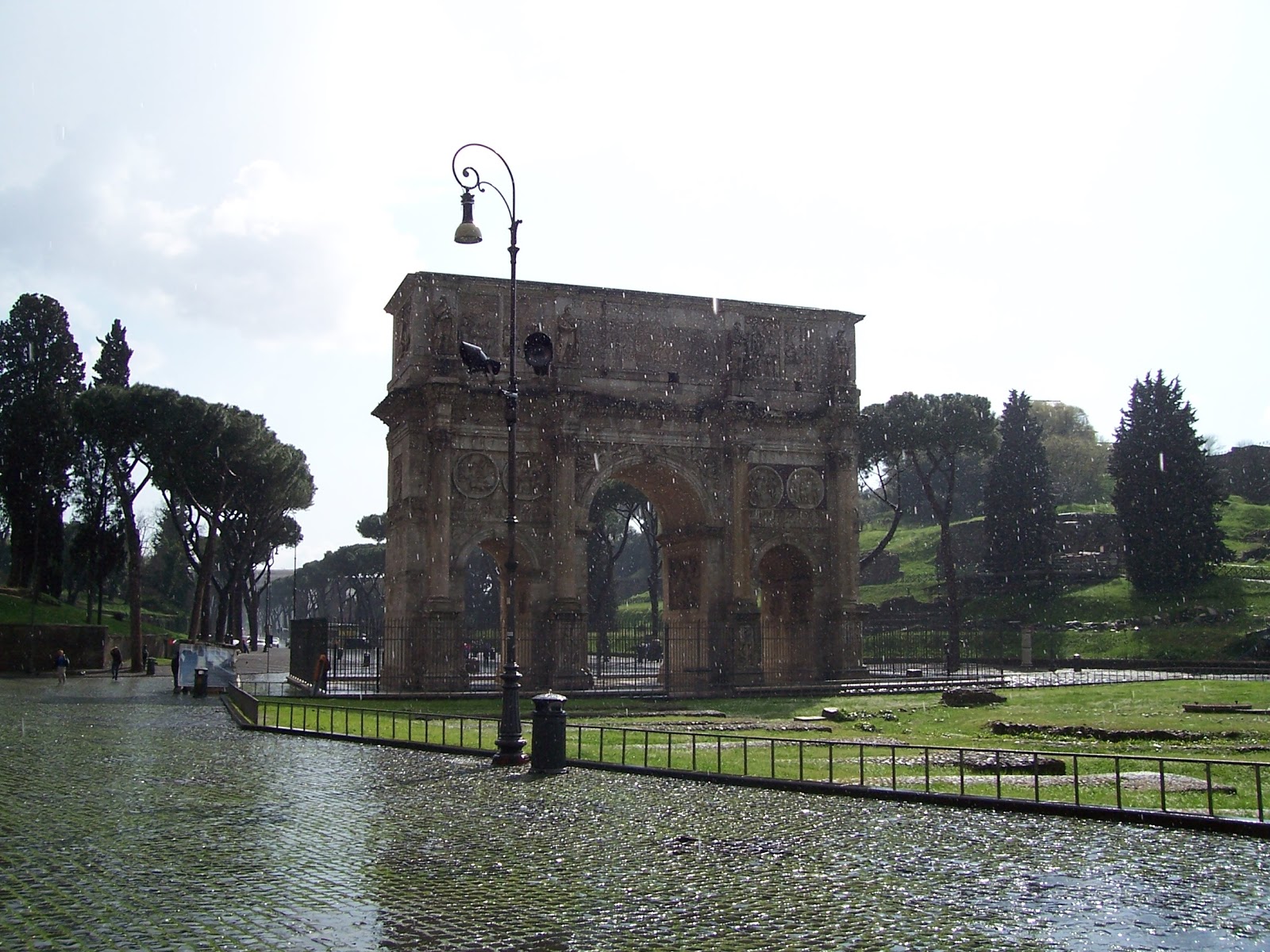
Except ... well, just look at these pictures I took after the storm had lightened up and I had second thoughts:


The Arch of Constantine was dedicated in 315 AD, to celebrate his defeat of Maxentius in 312 at the Battle of Milvian Bridge. It is the only Roman triumphal arch celebrating the defeat of another Roman. it is also the only such arch to use parts taken (stolen) from earlier buildings.
That said, it's a nice piece of work for the first Christian emperor. But do you notice anything?
The rain. You're used to seeing pictures of these monuments in the sun. Perfect photography weather. You rarely see them in inclement weather -- rain, snow or even clouds.
Rain. The Arch of Constantine is almost 1700 years old. The inconvenient storm did make me stop and think: how many rain storms has the Arch of Constantine endured? In 1700 years, how many storms has the arch survived?
Rain comes and goes. People come and go. Countries, nations, empires come and go. But the Arch of Constantine is still there.
The age, the timelessness of this monument to ancient Rome struck me then and there, all because of an inconvenient thunderstorm.
For comparison, here's a pic I took shortly thereafter of the retreating storm clouds over the Colosseum.
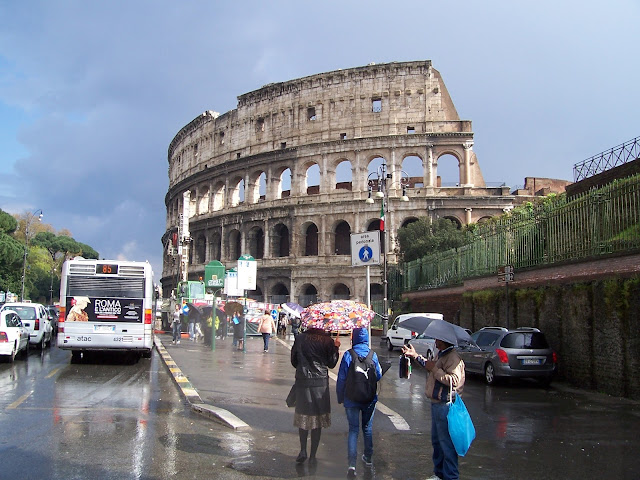
The Colosseum was started by the Emperor Vespasian and completed by his son Emperor Titus (from both of whom the Colosseum derives its official name Flavian Amphitheater) in about 80 AD. It's more than 1900 years old.
Rain comes and goes. People come and go. Countries, nations, empires come and go. But the Colosseum stays. Oh, sure, it's battered, it's bruised, it's gutted, but it's still there.
How many rainstorms has it survived?
Amazing. Remarkable. Incredible. A blessing.
Except ... well, just look at these pictures I took after the storm had lightened up and I had second thoughts:

The Arch of Constantine was dedicated in 315 AD, to celebrate his defeat of Maxentius in 312 at the Battle of Milvian Bridge. It is the only Roman triumphal arch celebrating the defeat of another Roman. it is also the only such arch to use parts taken (stolen) from earlier buildings.
That said, it's a nice piece of work for the first Christian emperor. But do you notice anything?
The rain. You're used to seeing pictures of these monuments in the sun. Perfect photography weather. You rarely see them in inclement weather -- rain, snow or even clouds.
Rain. The Arch of Constantine is almost 1700 years old. The inconvenient storm did make me stop and think: how many rain storms has the Arch of Constantine endured? In 1700 years, how many storms has the arch survived?
Rain comes and goes. People come and go. Countries, nations, empires come and go. But the Arch of Constantine is still there.
The age, the timelessness of this monument to ancient Rome struck me then and there, all because of an inconvenient thunderstorm.
For comparison, here's a pic I took shortly thereafter of the retreating storm clouds over the Colosseum.
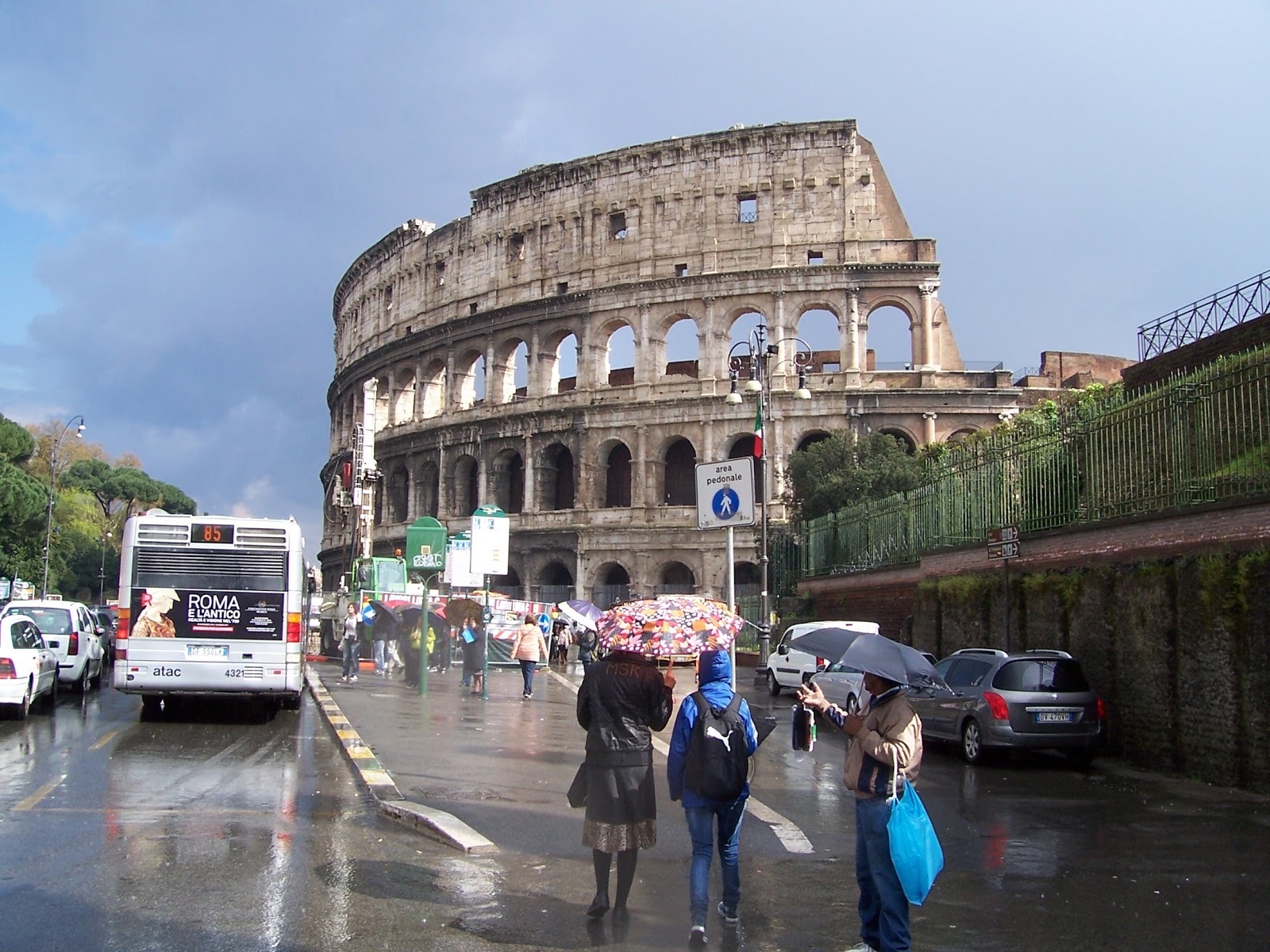
The Colosseum was started by the Emperor Vespasian and completed by his son Emperor Titus (from both of whom the Colosseum derives its official name Flavian Amphitheater) in about 80 AD. It's more than 1900 years old.
Rain comes and goes. People come and go. Countries, nations, empires come and go. But the Colosseum stays. Oh, sure, it's battered, it's bruised, it's gutted, but it's still there.
How many rainstorms has it survived?
Amazing. Remarkable. Incredible. A blessing.
Sunday, August 7, 2011
Questions about the 160th SOAR crash
Instapundit links to a Popular Mechanics article asking some pretty interesting questions about the loss of the helicopter carrying member of the US 160th Special Operations Aviation Regiment (SOAR), which included some 20 members of the Navy's SEAL Team 6, the guys who killed Usama bin Laden. The most important question, as I see it:
Which is why smart people never do such things.
And, yet, Barack Obama very intentionally did so.
Will special forces be put in greater danger during the drawdown of U.S. troops in Afghanistan?Indeed. When you announce you are withdrawing from a war zone without having the area secured or victory achieved, you are inviting such attacks on your troops.
Special Forces are expected to keep the pressure on the Taliban, working closely with Afghan forces to maintain control as U.S and Coalition troops depart. That means more raids, more targets and more reliance on Afghan competence—all of which add up to more special forces casualties.
This incident could be a sign of things to come: The crash happened in Tanji, where the U.S. closed a combat outpost in April. However, the AP has reported, the Afghan forces never staffed the outpost after American forces left, and the Taliban moved back in. That left it to Navy SEALs to undertake a dangerous raid in a notorious insurgent area to stem the Taliban's advance. As more responsibilities fall on the shoulders of special forces, the risk of more losses like this one will continue to increase.
Which is why smart people never do such things.
And, yet, Barack Obama very intentionally did so.
A crash in more ways than one
In Afghanistan the Taliban scored a victory when they shot down a US transport helicopter filled with members of our special forces, specifically the 160th Special Operations Aviation Regiment (SOAR). 31 American service people were killed, including some 20 members of SEAL Team 6, the unit that killed Usama bin Laden. Please keep the families of these brave, determined American heroes in your prayers.
There has been some concern expressed, specifically on Patterico's excellent blog, that this incident was an example of "loose lips sink ships," because Vice President Joe Biden mentioned that Navy SEALs were responsible for putting bin Laden in his place. While that concern is understandable and even warranted, I do not know that it should be overstated in this case. In contrast with most in this administration, Biden was trying to honor the military and give the troops their due. Losses do happen in war, and contrary to the apparent opinion of Obama, Valerie Jarrett and the State Department, we are at war with the Taliban. This should give pause to anyone who thinks that negotiating with the Taliban is a strategy that will lead anywhere but defeat.
There has been some concern expressed, specifically on Patterico's excellent blog, that this incident was an example of "loose lips sink ships," because Vice President Joe Biden mentioned that Navy SEALs were responsible for putting bin Laden in his place. While that concern is understandable and even warranted, I do not know that it should be overstated in this case. In contrast with most in this administration, Biden was trying to honor the military and give the troops their due. Losses do happen in war, and contrary to the apparent opinion of Obama, Valerie Jarrett and the State Department, we are at war with the Taliban. This should give pause to anyone who thinks that negotiating with the Taliban is a strategy that will lead anywhere but defeat.
Friday, August 5, 2011
Ominous signs and portents from the Muslim world
Very unpleasant to watch, but it must be done. Here we go:
Turkey:
Turkey:
Battle lines are being drawn across the Middle East.
On one side sit the forces of stability, with Saudi Arabia at the helm. On the other sit the forces of revolution, with Iran prominent in leadership. The alliances they lead are well known: the Gulf Sheikhdoms and Jordan align with the Saudis; Syria, Hamas, and Hizbollah with Iran. While both sides are equally capable of espousing Islamism and of violating the most basic human rights, the difference between them is very real. The Saudi-led bloc is quite content with the existing global order and the petrodollars that it bestows. The Iranian-led bloc is committed to toppling that order.
More new additions to the library
Imperial Roman Legionary AD 161-284, by Ross Cowan
Roman Military Equipment: From the Punic Wars to the Fall of Rome (2nd Edition), by M.C. Bishop and J.C.N. Coulston
Roman Military Equipment: From the Punic Wars to the Fall of Rome (2nd Edition), by M.C. Bishop and J.C.N. Coulston
Wednesday, August 3, 2011
UPDATED -- I want answers (It's Alexander the Great; see comments)
 |
| Unidentified bust in Rome's Aurelian wall on the Via Campagna caddycorner from the Hotel Victoria Roma. |
A Pantheon Sundial
Yes, Rome has party places like the beautiful Piazza Navona (site of the Emperor Domitian's circus, now it has a Cafe Domitian), the Spanish Steps (by which I was not impressed) and the Trevi Fountain (no one goes there -- it's too crowded -- though it has a great shop for Roman legion T-shirts), but to me nothing beats the party at the Pantheon piazza (aka the Piazza della Rotunda). Restaurants, music, singling, dancing, laughing, happiness, all underneath the Latin words "M.AGRIPPA.L.F.COS.TERTIUM.FECIT," which means "Marcus Agrippa, son of Lucius, having been consul three times, built it." This was Marcus Agrippa, Octavius Caesar Augustus' right hand man, who built it with Augustus after the Battle of Actium (Azio, in Italian). The Pantheon has been destroyed and rebuilt several times over the centuries. This one dates from the Emperor Trajan (aka Trajanus, Traianus, Traiano; Trajan is very popular in Rome, second to only Julius Caesar) and should be credited to his architect Apollodorus of Damascus, who apparently preserved Agrippa's original work. The Emperor Hadrian completed the reconstruction and kept Agrippa's name on the facade.
Tuesday, August 2, 2011
Judicial independence? Or infallibility?
I have been getting caught up on my past issues of Indiana Lawyer and I came across an article from June discussing the impact of unpopular decisions like Barnes v. State on the judiciary. The article is called "Touched by Controversy: 'Unpopular' rulings, public outcry can test courts and judicial independence." Sigh!
In the history of court controversies, a recent ruling by the Indiana Supreme Court has created public outcry and calls for change in ways that few others do.
But it’s not alone.
The courts have faced a handful of issues through the years pitting judges against public opinion, from a federal ruling on school desegregation in the 1970s to the governor criticizing a ruling that struck down the state’s voter ID law as unconstitutional in 2009. Trial and appellate judges once faced common law liens on their property from people upset about particular decisions, and the judiciary has stood up to attacks from lawmakers and residents who’ve taken issue with a holding that’s seen as “unpopular.”
One picture explains why I love Rome
 |
| It's a Pantheon Party. Every day. Every night. Antiquity and modernity mix in one swirl of fun! |
Monday, August 1, 2011
Turning point in Syria?
Several top Syrian generals have defected from Bashar Assad and joined the rebels:
A Syrian Major-General has deserted Assad's army along with a group of other officers and joined the rebels.
In an Arabic video clip posted on Youtube on July 29, 2011, the officer, Major-General Riad El As'ad is seen in the company of other officers, announcing the establishment of the "Free Syrian Army whose main goal will be to fight the army of oppression headed by President Bashar Assad".
As'ad accused the Assad regime of crimes against the Syrian people and called on the officers and soldiers in the Syrian army not to aim their weapons at the people. He further called on them to join the Free Syrian Army.
Subscribe to:
Posts (Atom)